A no-show at a nail salon isn't like missing a haircut. A skin fade can be rebooked in 45 minutes.
A full set of acrylic with nail art is two hours of someone's chair, plus the time you spent prepping the colours, plus the customer behind her who couldn't book that slot because it was "taken".
For most nail studios I work with, no-shows quietly eat 15–25% of weekly revenue. That's not a small number — it's the difference between hiring a junior nail tech this year or not.
The good news is that almost none of those no-shows are malicious. They're forgetful, double-booked, or stuck in KL traffic with no obvious way to tell you. Fix that, and the rest takes care of itself.
Here's the system I'd put in place at your shop tomorrow, in the order I've seen it work for nail-specific businesses.
1. Get the booking off WhatsApp DMs and onto a real booking page
Most nail salons in Malaysia still take bookings via Instagram DM or WhatsApp. The customer sends a message, you check your calendar, you message back, she confirms, you write it on paper.
This is the single biggest source of no-shows. Here's why:
- There's no commitment in DMing. Nothing is "booked" until you reply. The customer is mentally still browsing.
- You forget to confirm. Or you do confirm, but she didn't see your message — it's buried under 30 other unread chats.
- Reschedules happen by message too. She messages you Sunday night to change her Monday booking. You don't see it. She doesn't show up Monday.
The fix is a real booking page where the customer picks a service, a time, a tech, and enters her phone number. The system blocks the slot the moment she taps confirm. She gets a confirmation WhatsApp. The booking is real.
This single change drops no-shows by 30–40% at most nail salons we work with. Not because the booking page is magical, but because the commitment is real and the confirmation is automatic. (We built bookit for nail studios around this exact insight.)
2. Send the right reminder at the right time
Most "reminder" software in the market sends one reminder, 24 hours before the booking. That's fine for short appointments. It's not enough for a 2-hour gel set.
Here's the cadence that actually works for nail salons:
| When | Channel | Message |
|---|---|---|
| At booking | Confirmation with date, time, service, deposit (if any) and a one-tap reschedule link | |
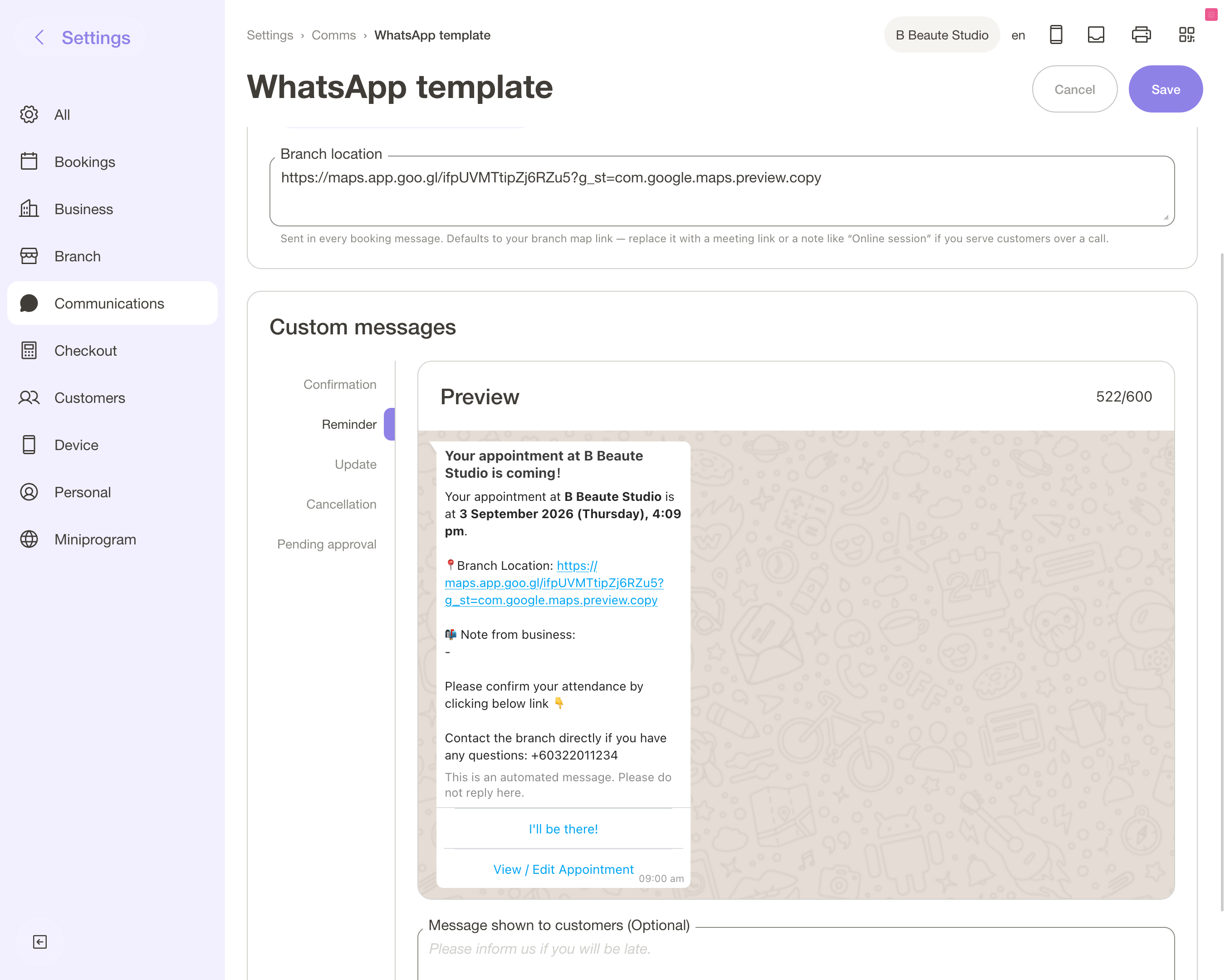
| 48 hours before | "Looking forward to seeing you Tuesday at 2pm for your gel mani — please come with bare nails" | |
| 2 hours before | "Hi — your appointment is in 2 hours. Reply to reschedule if needed." |
The 48-hour message is the one most salons skip — and it's the one that catches the customer who forgot it was this week. The 2-hour one catches the traffic / sick child / forgot situation while there's still time for you to fill the slot from your waitlist.
Three reminders is the right number. Four feels naggy. One is not enough.
3. Make rescheduling frictionless — easier than no-showing
This is counterintuitive. Most salons make rescheduling hard because they don't want to be cancelled on. The result: the customer can't easily change the booking, so she just doesn't show up.
Make it easier. In every reminder, include a one-tap link that lets her pick a new slot herself. No "please call us to reschedule." No "please reply with three preferred times."
When rescheduling is one tap, customers reschedule. When it's a friction-laden phone call, they no-show.
Yes, you'll see more reschedules in your dashboard. That's not a bad thing — a reschedule is revenue saved. A no-show is revenue lost.
4. Use deposits — but only where they matter
I'm careful about recommending deposits because they're a customer experience trade-off. Take a deposit and you commit the customer; take a deposit on the wrong booking and you irritate her.
The rule of thumb for nail salons:
- No deposit on first-time customers booking a short service (express mani, polish change, soak-off). Friction kills new customers more than no-shows do.
- No deposit on regular customers booking standard services. They show up. Trust them.
- Deposit on long services (2+ hours: full acrylic sets, intricate nail art, soak-off + new set combos). These are the most expensive no-shows and the customer expects the protection.
- Deposit on first-time customers booking a long service. They've never been to you; you need the commitment.
Standard deposit amount: 50% of the service price, refundable up to 24 hours before. Anything stricter is hostile. Anything looser doesn't actually protect you.
In bookit, deposit rules are per-service — set it once, the system enforces it forever. The customer gets a clear "Pay RM75 deposit to confirm" CTA on the booking page. No human intervention needed.
5. Build a real waitlist (and use it)
Even with the best reminder cadence, you'll have no-shows. When you do, you want a way to fill that 2pm slot in the 10 minutes after it gets cancelled, not in an hour.
The waitlist that works in practice:
- Every customer who's tried to book a sold-out slot in the last 2 weeks goes into a waitlist for that service.
- When a slot opens up (cancellation, reschedule, no-show), bookit fires a one-tap WhatsApp to the top 3 waitlist customers: "A 2pm slot has just opened today — tap here to take it."
- First to confirm wins.
This converts roughly 30–50% of last-minute openings into filled bookings, which is the difference between a wasted hour and a paid one.
The waitlist only works if it's automatic — manually messaging waitlisted customers is fine until you forget once or twice and stop doing it. Make it run by itself.
What I see at salons that get this right
A real example, anonymised. A nail studio in Mont Kiara, 3 techs, doing about RM45K/month in service revenue. Pre-system: no-show rate around 22%, mostly on 2-hour bookings. Post-system (real booking page, three-touch reminders, deposit on long services, automated waitlist): no-show rate dropped to 7% in three months. That's RM6,700/month in recovered revenue, give or take.
That's not because we sold them magic. It's because:
- Bookings were committed at the page, not in a DM
- The 48-hour-out reminder caught half the would-be no-shows
- Deposits eliminated the worst no-shows entirely
- The waitlist filled most of the remaining slots within an hour
You can build this without bookit specifically — there are other tools that do most of these. The key is doing all five steps together. Doing one or two is the same as doing none.
The things to not do
A few traps I see salons fall into:
- Don't charge a "no-show fee" you can't actually collect. Threatening RM50 you'll never bill is worse than no policy at all — customers see through it. Either take a real deposit, or don't.
- Don't send four reminders. Three is the sweet spot. Four feels desperate.
- Don't make rescheduling require human intervention. Every friction point loses a percentage to no-show.
- Don't take deposits from regulars. It signals you don't trust them. Treat trust like a feature.
How to start tomorrow
If you don't want to commit to new software yet, start with the playbook:
- Pick one tool that sends WhatsApp reminders automatically (bookit, Aoikumo, or even a basic standalone reminder tool).
- Set the three-touch reminder cadence.
- Pick one or two of your longest services and add a deposit requirement, refundable 24h before.
- Keep a manual waitlist for two weeks and message the top 3 customers when a slot opens. If you find this works, automate it.
If you want to do all five at once, every plan starts with 7 days free, so you can try the full setup before you pay anything. We'll help you migrate your service menu and existing customer list — most nail salons are up and running in a single afternoon.
The most expensive no-show is the one you didn't have to take. Set up the system once, run it for a quarter, and you'll see the difference in your monthly numbers without doing anything else.