返回博客
compliance7 分钟阅读

What is e-Invoice, and does your beauty salon need it?

LHDN e-Invoice is rolling out in waves across Malaysia in 2026. Here's what it is, when your salon has to comply, and how to set up so it isn't a headache.

Lydia Lai
Founder, LaunchIt
这篇文章尚未翻译 — 显示英文版本。

There's a lot of confusion in the beauty industry about LHDN's e-Invoice mandate. Half the salon owners I talk to think they're not in scope yet. The other half think they are but don't know what they're supposed to do.

This is the post I wish someone had written me clearly when the policy first dropped. No jargon, no lawyer-speak — just what you actually need to know to keep running your salon without an LHDN letter showing up.

Disclaimer: I'm a software founder, not a tax advisor. The dates and thresholds below are based on the most current LHDN public guidance at the time of writing (May 2026). If you're close to a threshold or unsure about your specific situation, talk to an accountant. Don't bet your business on a blog post.

What e-Invoice actually is

In one sentence: an e-Invoice is a digital receipt that gets submitted to LHDN in real time at the moment of the sale, and the customer's copy includes a unique tracking ID (UUID) that proves it was submitted.

Old way: customer pays RM200 for a facial, you print her a receipt, you write it down in your books, you tally everything at year-end.

New way: customer pays RM200 for a facial, your POS sends the transaction to LHDN's MyInvois system, MyInvois returns a UUID + QR code, your POS prints the receipt with that UUID on it. The receipt is now an e-Invoice. Your tax filing at year-end is largely automatic because LHDN already has the data.

That's the whole concept. Everything else is implementation detail.

Why LHDN is doing this

A few reasons, in plain language:

  1. Closing the cash economy gap. A lot of small-business revenue in Malaysia historically didn't show up in tax filings because it was cash and untracked. e-Invoice makes that much harder.
  2. B2B reconciliation. Companies buying services from each other need a paper trail. Manual invoicing produces a lot of errors and disputes; e-Invoice fixes most of them.
  3. Pre-filled tax returns. Long-term goal — LHDN already knows your revenue, so your filing becomes confirmation rather than data entry.

You may or may not like the policy. That's a separate conversation. The point is: it's law, the timeline is real, and salons need to be ready.

The rollout timeline — when does it apply to your shop?

LHDN is rolling e-Invoice out in waves, by annual turnover. Here's the timeline as of writing (May 2026):

Phase Effective Annual turnover
Phase 1 August 2024 >RM100 million
Phase 2 January 2025 RM25M to RM100M
Phase 3 July 2025 RM5M to RM25M
Phase 4 January 2026 RM500K to RM5M
Phase 5 July 2026 RM150K to RM500K
Phase 6 January 2027 All other businesses (below RM150K)

The vast majority of beauty salons fall into Phase 4 or Phase 5. A handful of larger chains hit Phase 3. The smallest solo operators are in Phase 6.

Translation for a salon owner:

  • If your shop made more than RM500K last year, you're in scope right now. You should already be issuing e-Invoices.
  • If your shop made between RM150K and RM500K, you have until July 2026 — that's about two months from when this article goes up.
  • If your shop made under RM150K, you have until January 2027 — but most likely you'll want to be ready earlier.

LHDN runs a six-month interim consolidated e-invoice arrangement, so even after the mandatory date, there's some flexibility for low-volume businesses. But the direction of travel is clear: get ready ahead of your wave, not after.

What "issuing an e-Invoice" actually looks like

There are two ways to do this in practice:

The manual way — MyInvois Portal

LHDN runs a free web portal called MyInvois. You log in, fill out a form for each invoice (customer details, line items, tax), submit, and get back a UUID + PDF receipt.

This works but the friction is significant. About 30–60 seconds per transaction. For a salon doing 20 transactions a day, that's 10–20 extra minutes of admin every day. By the end of a month it's hours of work that doesn't pay anything.

It also requires you to enter the customer's TIN (Tax Identification Number) for B2B receipts. For B2C (walk-in customers without a TIN), you can issue under a consolidated TIN — but each one still needs filling out individually.

The manual path is fine if you do 2–3 transactions a day. For most service businesses, it's not sustainable past the first few weeks.

The integrated way — POS that submits automatically

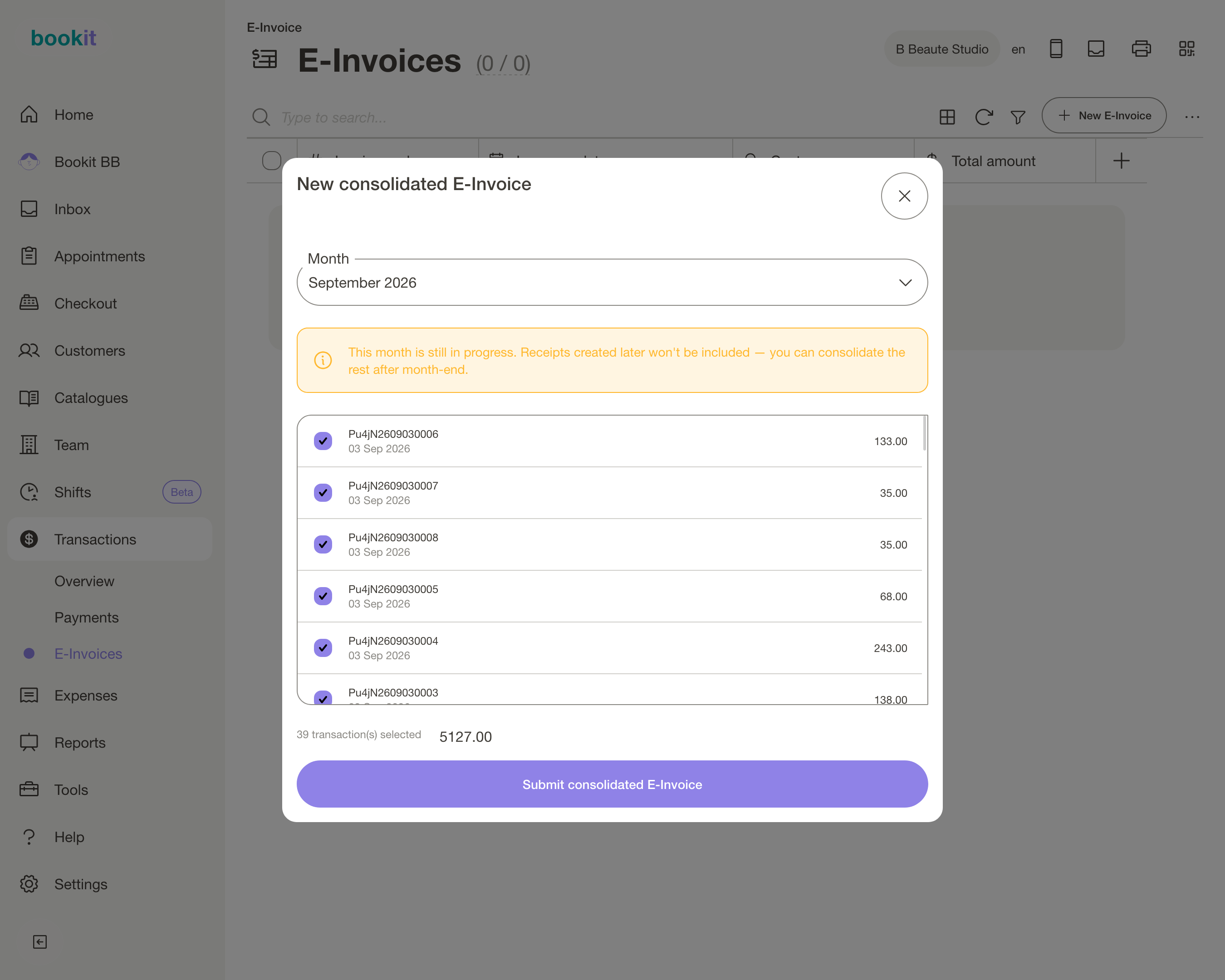
A POS system with e-Invoice integration submits every transaction to MyInvois automatically as part of checkout. The UUID comes back, prints on the receipt, sends to the customer on WhatsApp or email, and your books are updated. The customer doesn't notice anything different.

The 30-second-per-transaction tax disappears. The risk of typing errors disappears. The end-of-year reconciliation becomes trivial.

The catch: your POS has to actually support LHDN e-Invoice. International tools like Fresha, Square and Setmore don't — they're not built for the Malaysian regulatory environment. Local tools that have built it in include bookit, Aoikumo, Tunai, and StoreHub.

If you're shopping for new POS software in 2026 and e-Invoice isn't on the feature list, that's a deal-breaker. Walk away.

The fields you need ready

Whether you go manual or integrated, e-Invoice requires more data than a regular receipt. Things you might not be collecting today but will need to:

  • Your business's TIN (Tax Identification Number from LHDN)
  • Your SSM registration number
  • Your address as registered
  • Customer's TIN for B2B invoices (or a default consolidated TIN for B2C walk-ins)
  • Itemised lines — each service / product as its own line with quantity, unit price, total
  • Tax breakdown — SST if applicable
  • Payment method — for the e-Invoice metadata

If your current POS doesn't have these fields, you're going to be doing extra typing in MyInvois portal — even if you eventually move to a POS that does have them, you'll need to retro-populate.

What I'd do this month, even if your phase isn't here yet

Three things, in order:

  1. Find your annual turnover for the last 12 months. Sit with your accountant if you don't know off the top of your head. Match it against the phase table above. You now know your deadline.
  2. Find out if your current POS supports LHDN e-Invoice. Email them, check their public docs. If they don't, decide whether to switch. The switch is easier in a quiet month than in a panic 60 days before your phase.
  3. Get your TIN sorted now. If you don't have one, applying takes 1–2 weeks at LHDN. Don't be the salon scrambling for a TIN the week before the mandate hits.

If you're considering bookit specifically: every checkout generates an LHDN e-Invoice with the UUID and QR code, delivered to the customer on WhatsApp. You set up your TIN once at onboarding and never think about it again. Pricing is RM488/year per branch with a one-month RM49 trial so you can verify the e-Invoice flow on real transactions before committing.

What happens if you ignore it

I'm not in the business of doom-mongering, but the LHDN penalty schedule for failure to issue e-Invoice when in scope is, at the time of writing, RM200 to RM20,000 per non-compliance instance.

In practice — and again, this is what I'm seeing in the market, not legal advice — LHDN seems to be running a soft-enforcement period in the early waves. The penalty exists; the enforcement intensity is gradual. Don't take that as a hall pass. The penalty schedule isn't going to get gentler, and once your phase has been live for a while, "I didn't know" stops being an answer.

The summary

e-Invoice isn't a software industry-only thing. It applies to every salon, spa, barbershop and nail studio in Malaysia, with the only question being when. Most beauty businesses will be in scope by mid-2026.

If you do nothing else this quarter:

  • Confirm which phase you're in
  • Make sure your POS supports it (or plan to switch)
  • Have your TIN sorted

That's most of the work done. The rest is just making sure the receipts get submitted, and that happens by itself once your tools are set up correctly.

For the wider picture on running a salon in 2026, you might also like: