
Ask most salon or clinic owners in Malaysia what they actually do all day, and the honest answer is not cutting hair or seeing clients. It is answering questions only they can answer.
Who is working Thursday. Did Aina come in at 10 or 10:40. Is anyone at the counter at 2pm. How many hours do I owe Farah this month. Did we agree 10% or 12% on retail.
None of these are hard questions. They are only hard because the answer is in one place — your head — and there is no second copy.
That is the thing worth naming, because it gets mistaken for something else. Owners tell us they have a trust problem with their team. Almost none of them do. What they have is a recording problem.
Nothing was written down at the time it happened, so four weeks later two honest people have two different memories and no way to settle it. Trust gets blamed for what is really an admin gap.
And the bill for that gap is not the arguments. It is that you cannot leave.
The real cost is that the shop needs you in it
Here is the test we use with merchants. Could you go away for one week — actually away, phone off — and have the shop run exactly the same?
For most, the answer is no, and the reason is never the skill of their team. It is that four or five decisions a day route through the owner because only the owner has the information.
The roster is a WhatsApp message you sent, so you are the only one who knows what the current version is. Attendance is your observation, so if you are not there, nobody is recording anything. Commission is a number you agreed verbally with each person, so only you can settle a query.
You have not built a business yet. You have built a job with a payroll attached.
Getting out of that does not start with hiring a manager. It starts with moving three things out of your memory and into somewhere anyone can read.
1. The roster: one place, one current version
The Sunday-night group chat is not a bad roster because it is WhatsApp. It is a bad roster because it has no current version.
Every correction is a new message, and the newest message is usually just the last thing that changed, not the whole picture. Ask five people what Thursday looks like and you get five answers, all sincerely held.
What you want is a place where "who is working Thursday" is answered by looking at Thursday — not by scrolling.
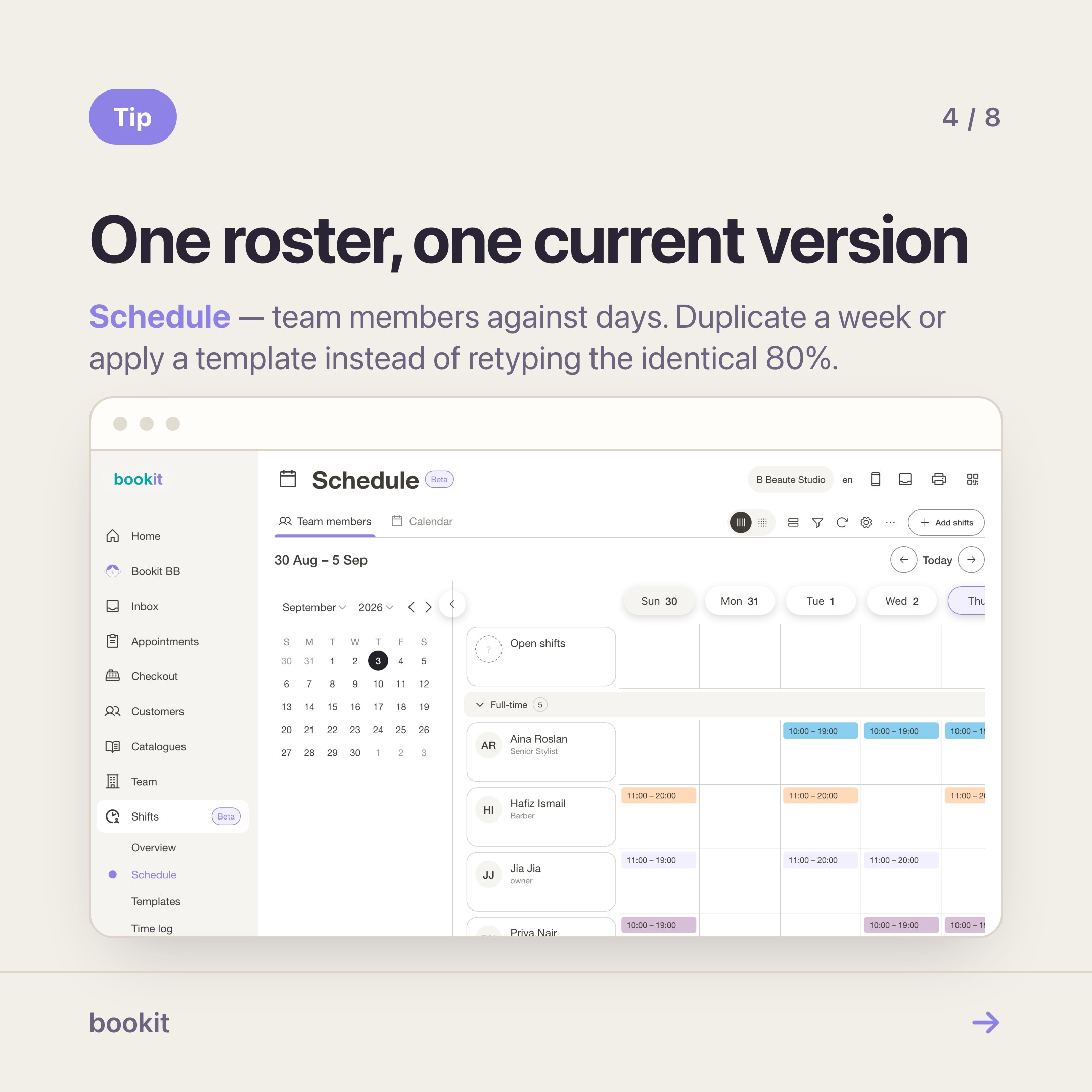
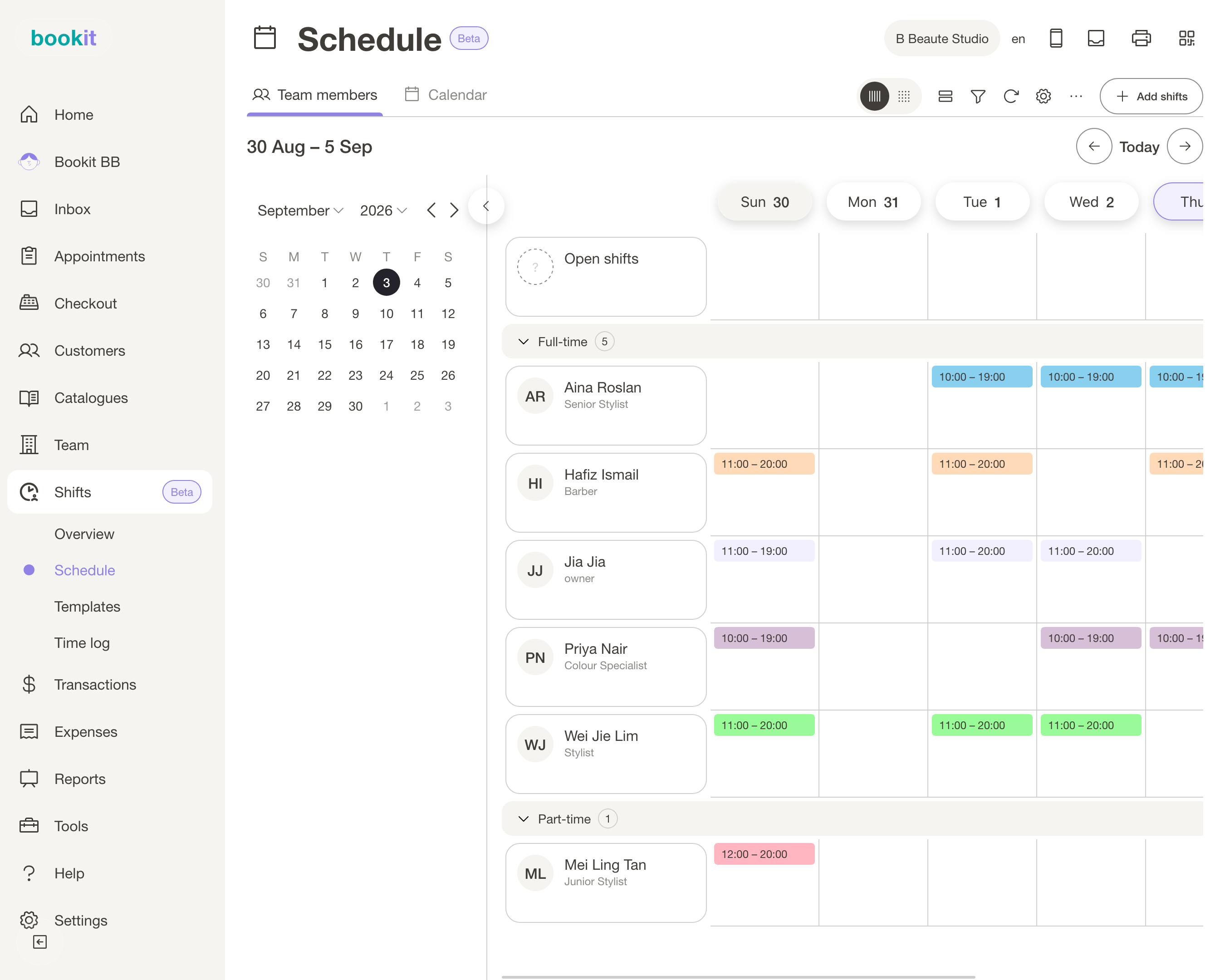
In bookit's Shifts, that is the Schedule page: a grid of team members against days, week or month. Anyone with access opens it and sees the same thing you see. When you change it, it is changed — there is no older message still circulating.
The second half of this matters more than it sounds. Look at last week's roster next to this week's; for most shops 70 to 80% is identical. If you retype that every Sunday, you spend an hour a week producing something you already had.
So build a week once, then Duplicate day or Duplicate range to push it forward, or Save week as template and apply it. If someone has usual weekly hours, set them once on their team member profile as a default shift schedule and applying a template fills their calendar for you.
Rostering stops being a writing job and becomes an editing job. That is a much smaller thing to be the only person capable of doing.
2. Attendance: recorded at the time, by the person it is about
A roster records your intention. It says Aina was meant to work 10 to 6. It does not say whether she did.
For most merchants we talk to, nothing records that at all. There was never a punch card, never a sign-in book. The gap is invisible until the month ends and it becomes the entire conversation.
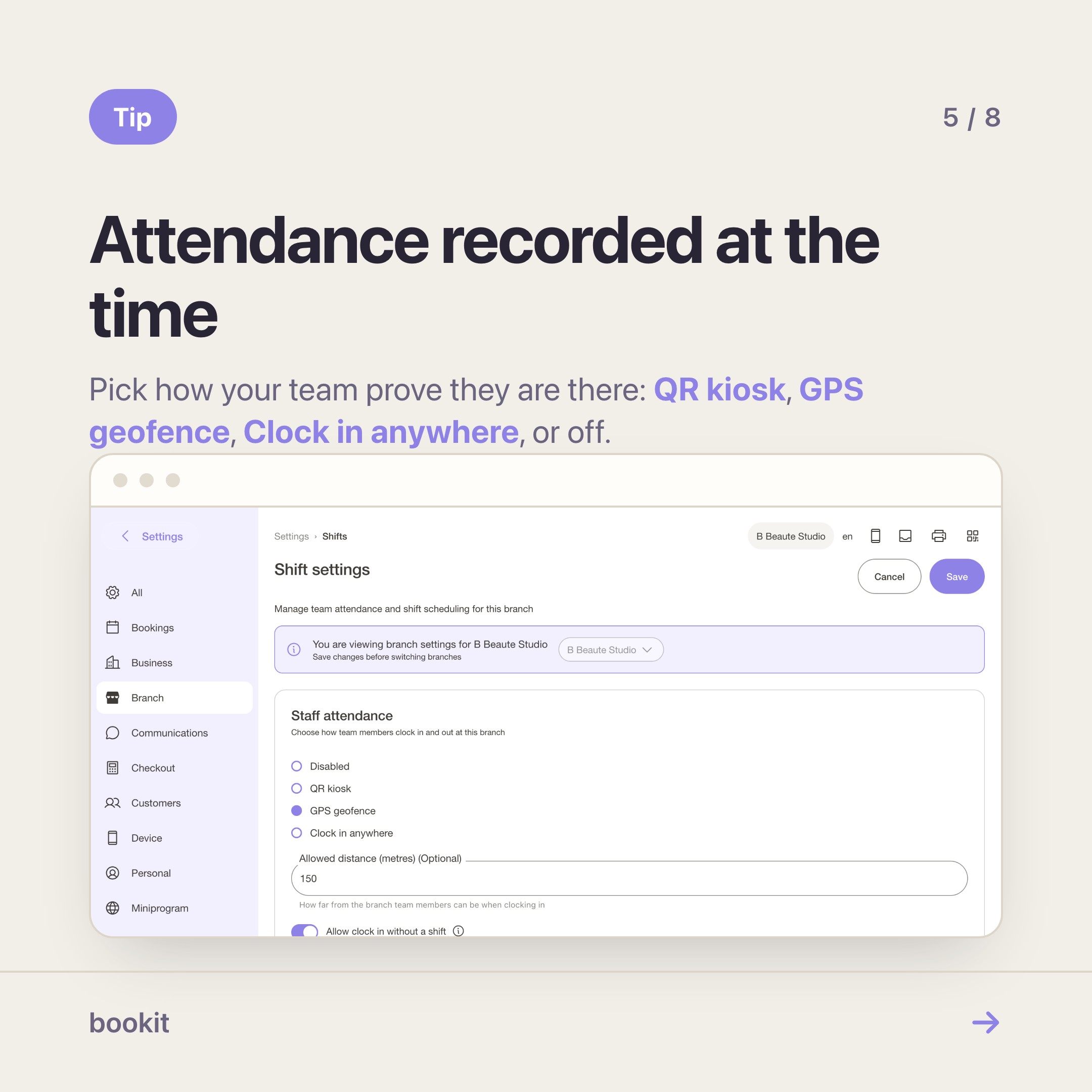
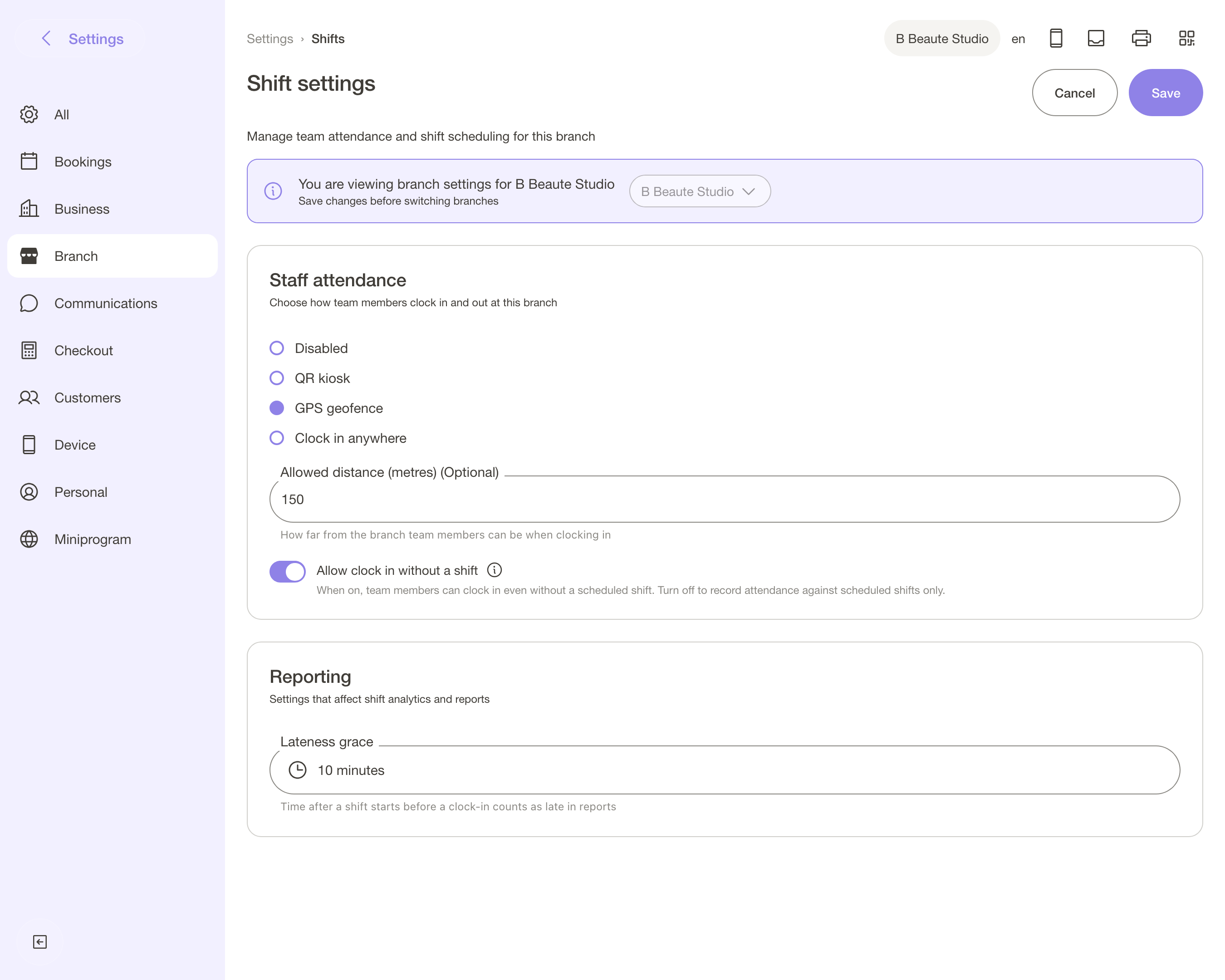
So your team clock in and out themselves — on their own phone, or on a shared screen at the counter. You choose per branch how much proof you want:
- QR kiosk — a code on a screen at your counter that changes constantly and works once. A screenshot is worth nothing.
- GPS geofence — they clock in on their phone and must be within a distance you set of the branch. Default is 150 metres.
- Clock in anywhere — no location check at all. Honest about what it is; fine for remote or long-trusted people.
- Disabled — nobody clocks in and you run on the roster alone.
Every clock-in is recorded against that person's own bookit account, with the time and the method used. Not a shared PIN, not a name on a sheet. That is the part that still means something four weeks later.
Notice what this does to the trust question. You are not watching anyone. You are removing the situation where somebody's pay depends on what you happened to notice.
3. Money rules: written down once, not renegotiated monthly
The third thing living in your head is what each person earns on what. The 10% on services, the flat RM5 on retail, the different deal you gave the senior stylist two years ago because she brought her own clients.
In bookit that goes into a commission pattern per branch, and the numbers are then calculated at the moment each payment is taken and stored with it.
Two consequences worth knowing: nobody has to remember the deal, and changing the pattern later does not quietly rewrite what happened last month. Then Reports, then Team member commission report, answers a query without either of you reconstructing anything.
What month end looks like after this
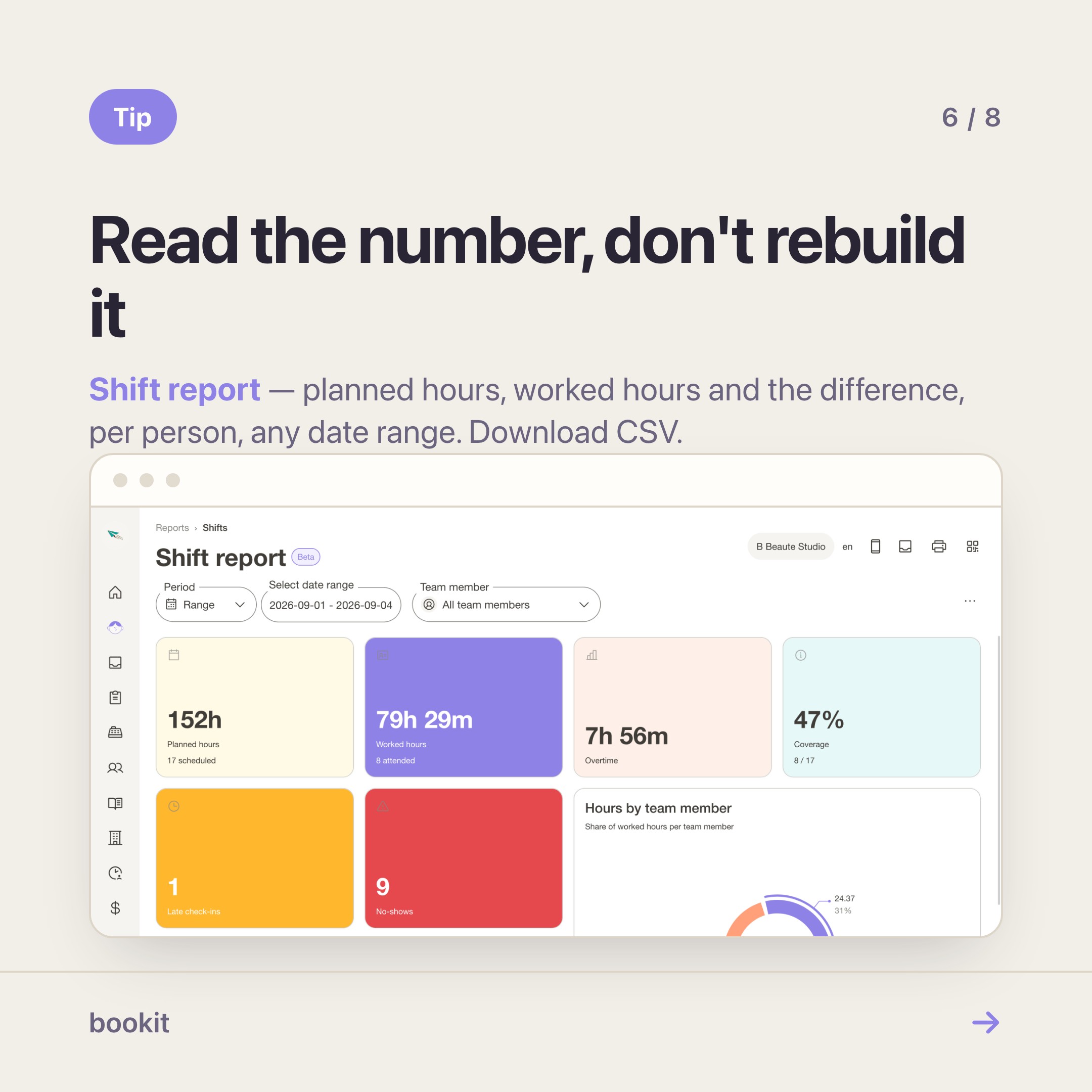
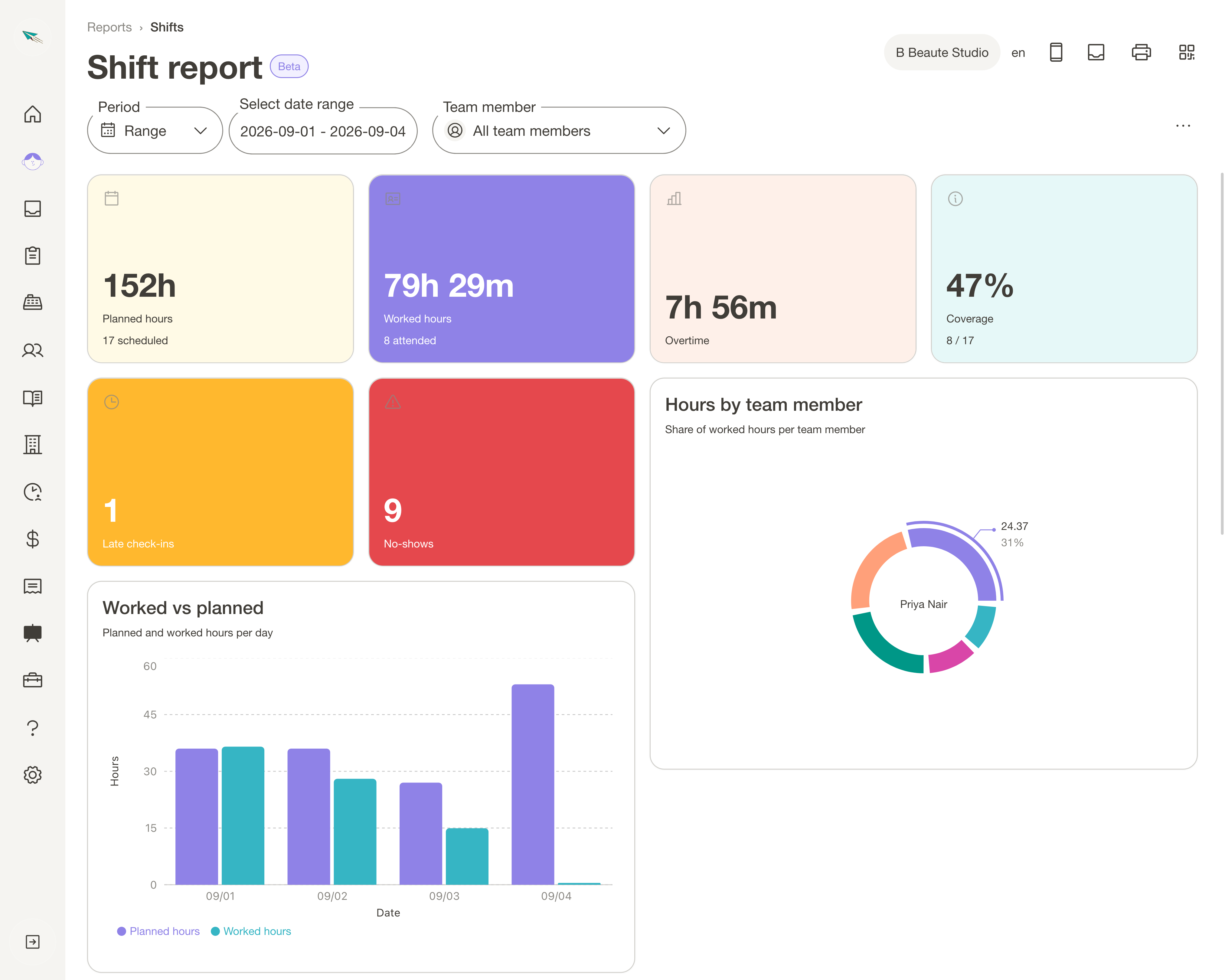
Reports, then Shift report, over any date range: planned hours, worked hours and the difference, per person. Coverage across the period. Punches nobody linked to a shift. Clock-ins nobody closed. Filter to one person when they query their number, and Download CSV for whoever does your payroll.
You are not winning the argument faster. The argument stops happening, because there is something to look at.
Where we drew the line
Some of this is a decision, some of it is a queue. Worth knowing which is which before you start.
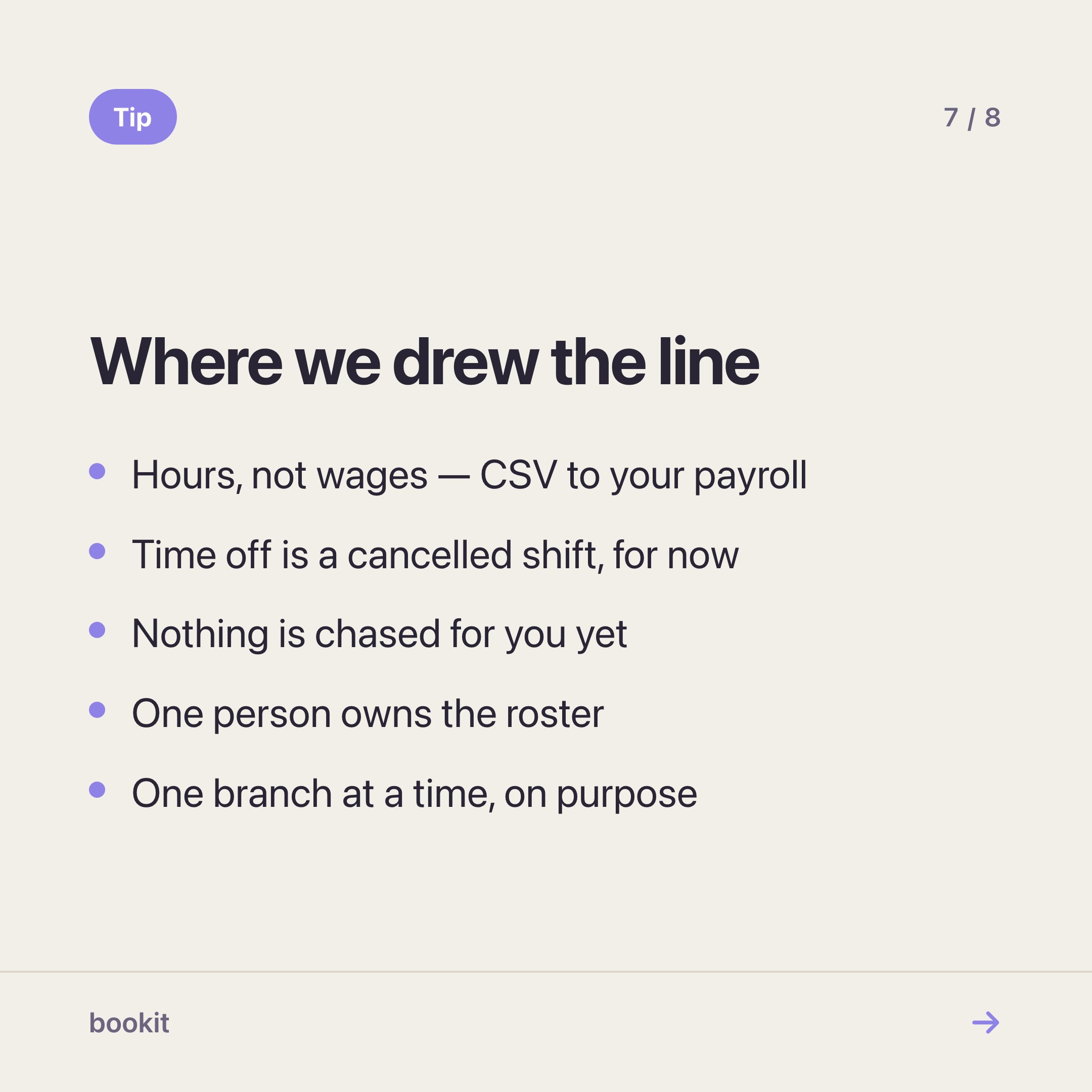
Hours, not wages. Shifts records hours and stops there, on purpose. Wages pull in rates, overtime multipliers, EPF, SOCSO and deductions — hold those and you are a payroll system with a legal duty attached, and we would rather do one job properly. Hours are also the part both people in the room can agree on. Download the CSV and hand it to whoever does your payroll.
Time off is a cancelled shift, for now. There are no leave balances yet. When someone is off you cancel the shift — the cancellation stays on its history and it stops counting as a no-show, so your numbers stay clean. A proper leave record with balances is a bigger piece of work, and we would rather build it once than bolt on a checkbox.
Nothing is chased for you yet. No roster reminder, no late alert, no nudge about an open clock-in. Open clock-ins sit on the overview for you to spot. This is the honest gap rather than a design choice — if your hope was to stop chasing people, wait for that one.
One person owns the roster. You can leave a shift unassigned as an open shift, but a manager assigns it; nobody claims one. That keeps the roster to a single version of the truth, which is the whole point of moving it off the group chat. Swaps need a request-and-approve flow behind them, and a half-built one is worse than none.
One branch at a time. Rostering, coverage and lateness are branch-level facts — average two branches together and you hide the exact gap you opened the page to find. A roll-up view is on the list for merchants running several.
If one of those is the thing you actually needed, tell us and it moves up the list.
Where to start
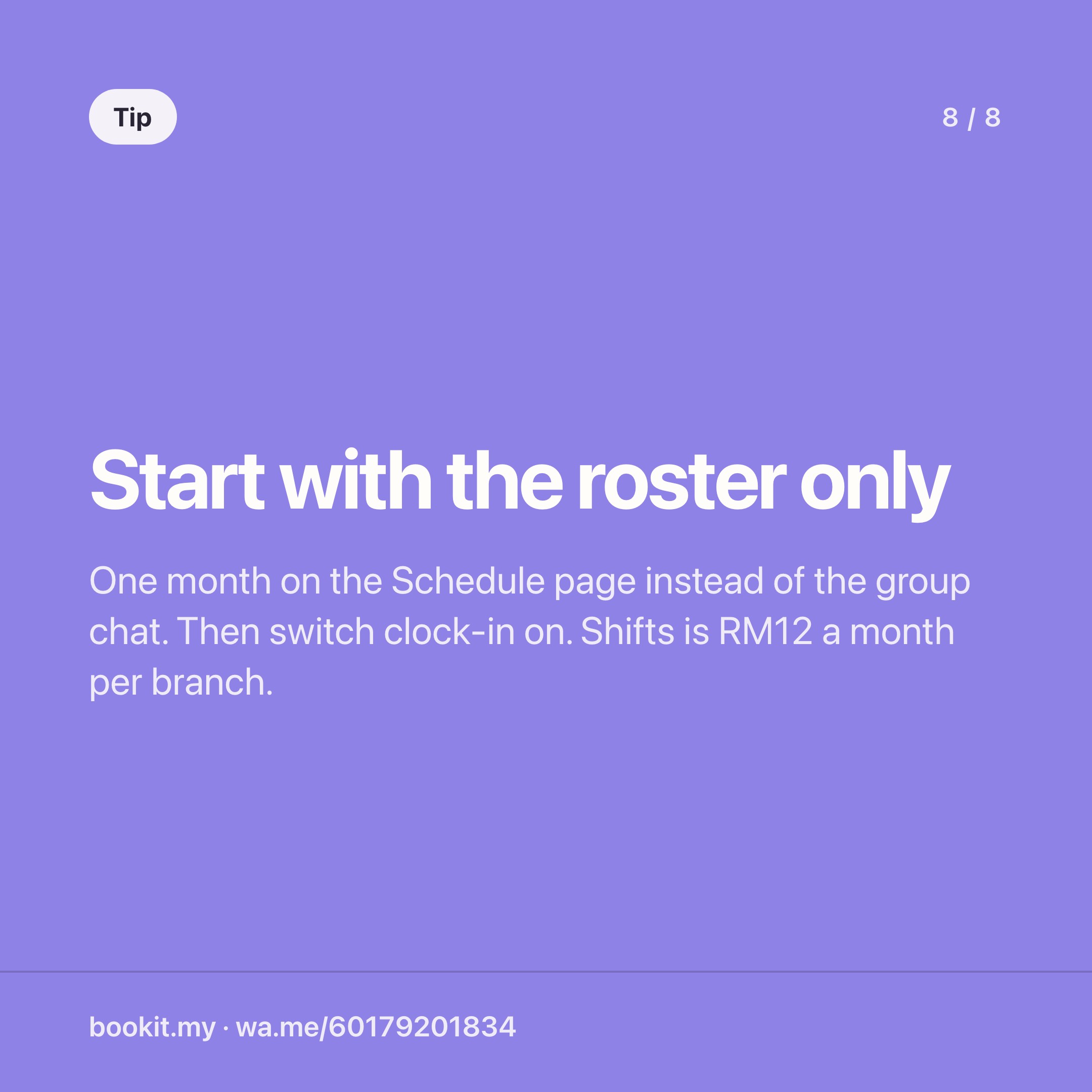
Shifts is an optional add-on, RM12 per month per branch on Basic, Advance and Team, or RM100 per year per branch annually. It is on our pricing page with the other add-ons, and you add it yourself from your subscription page — it is live on that branch immediately.
Start with the roster only. Get one month of the week living on the Schedule page instead of the group chat, and leave attendance switched off. Once nobody is asking you what they are working, switch clock-in on and give it another month. Then open the report.
You will see a beta badge on it in the app. That is deliberate — it is new, and the merchants using it now are shaping what comes next.
Read next: once the roster is running, templates, the shift report and paying part-timers from one export is the half that saves you Sunday nights.
Not sure it fits your shop? Talk to us on WhatsApp — five minutes, and we will tell you honestly if the answer is no.